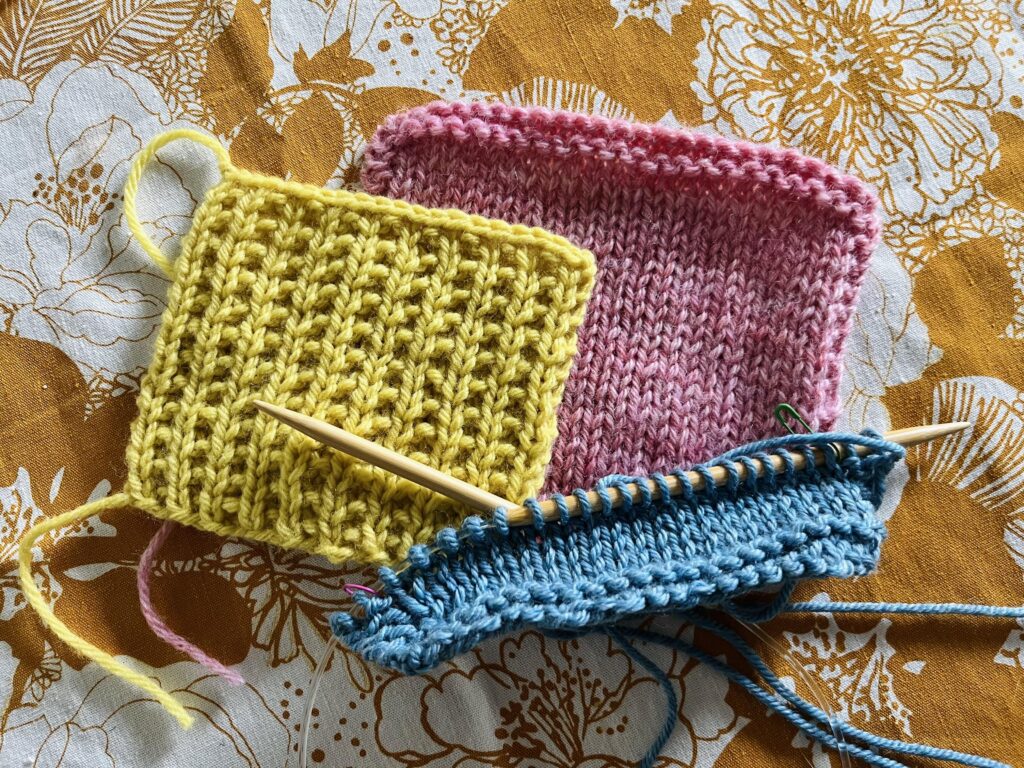
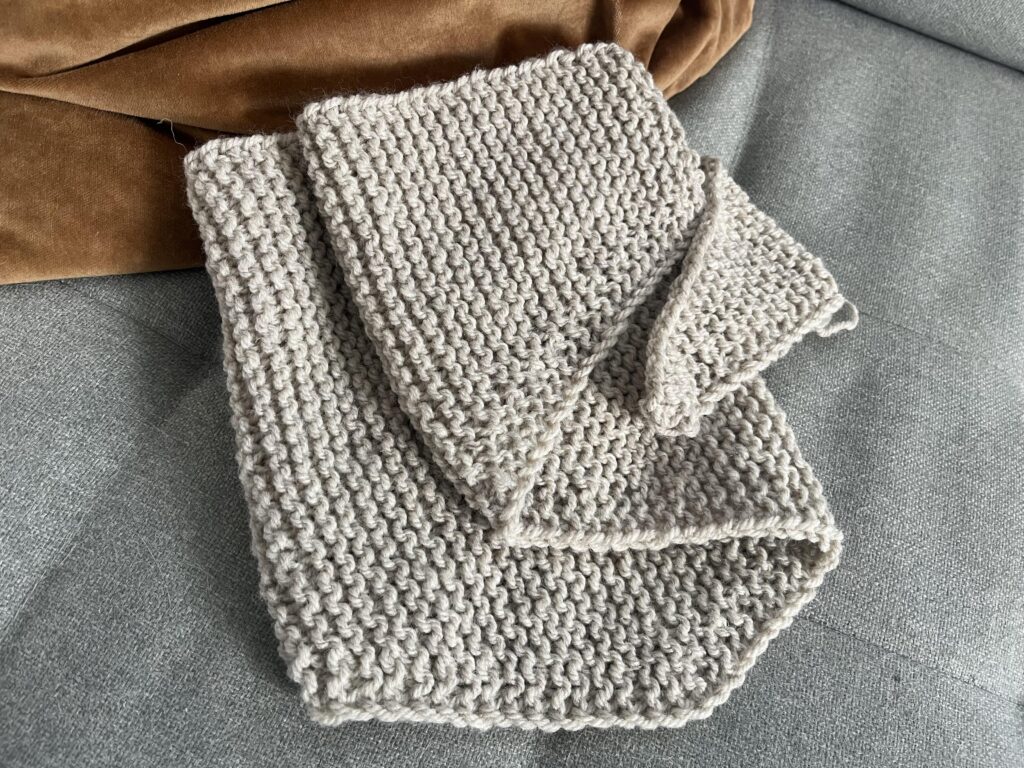
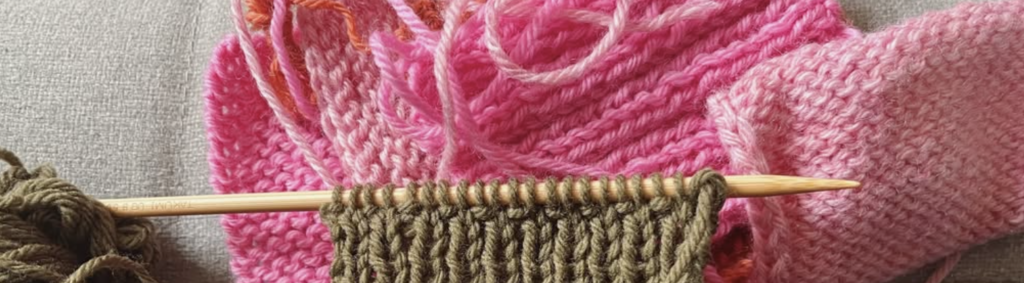
Teaching knitting in a group setting has taught me so much, and I am so grateful to all the folks that came to learn something new and challenging! It’s no joke, trying to get your fingers to do all new things makes you feel like a baby learning to walk, except we didn’t have much of an ego going as babies… the patience and vulnerability required to learn with others is something beautiful to behold.
Over the spring and summer I’ll be offering one-on-one and small group classes, all sliding scale or skills-exchange. I’ll have everything from absolute beginner to workshops on specific skills, like hats, socks, lace, cables, and color work.
And in the meantime, now that I’ve learned how to make video tutorials on YouTube, I’ll be building out a library for beginner knitters! Hopefully, I’ll also figure out how to make my set-up a bit more stable so the camera doesn’t shake every time I bump my desk… [grimace emoji]
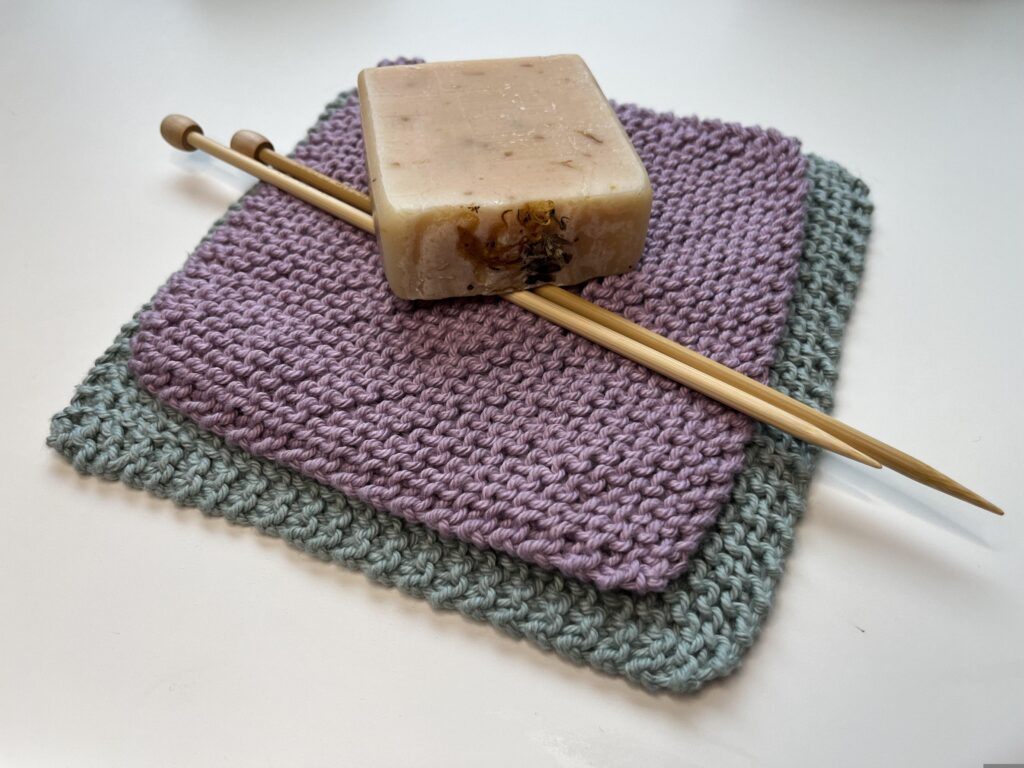
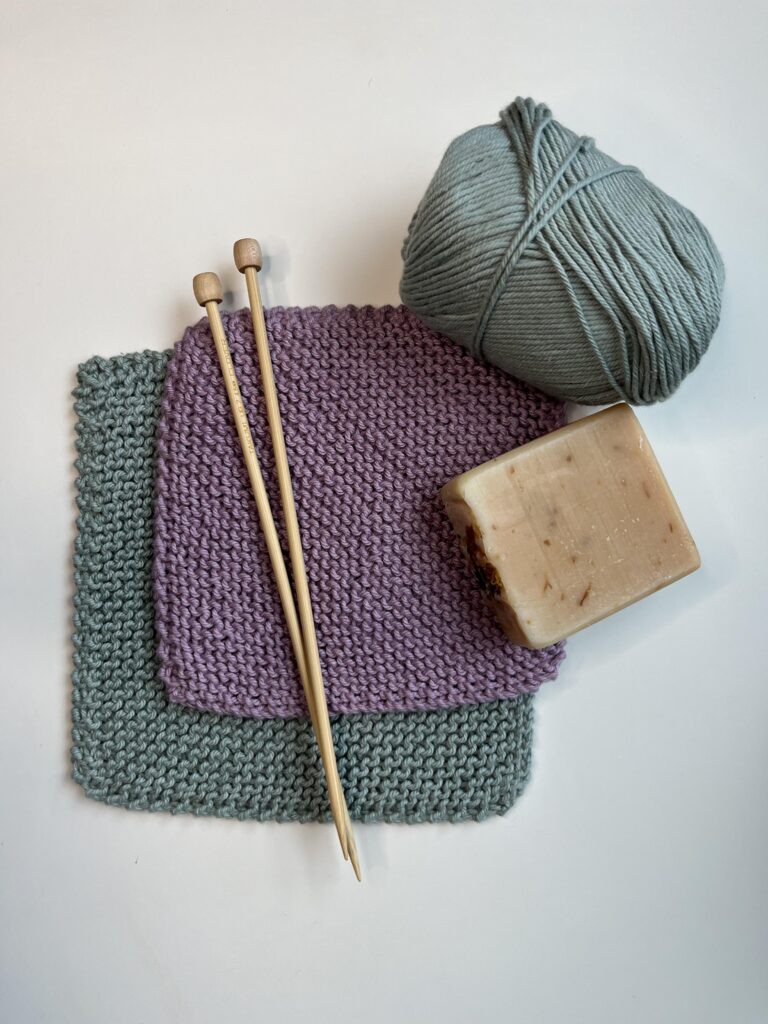
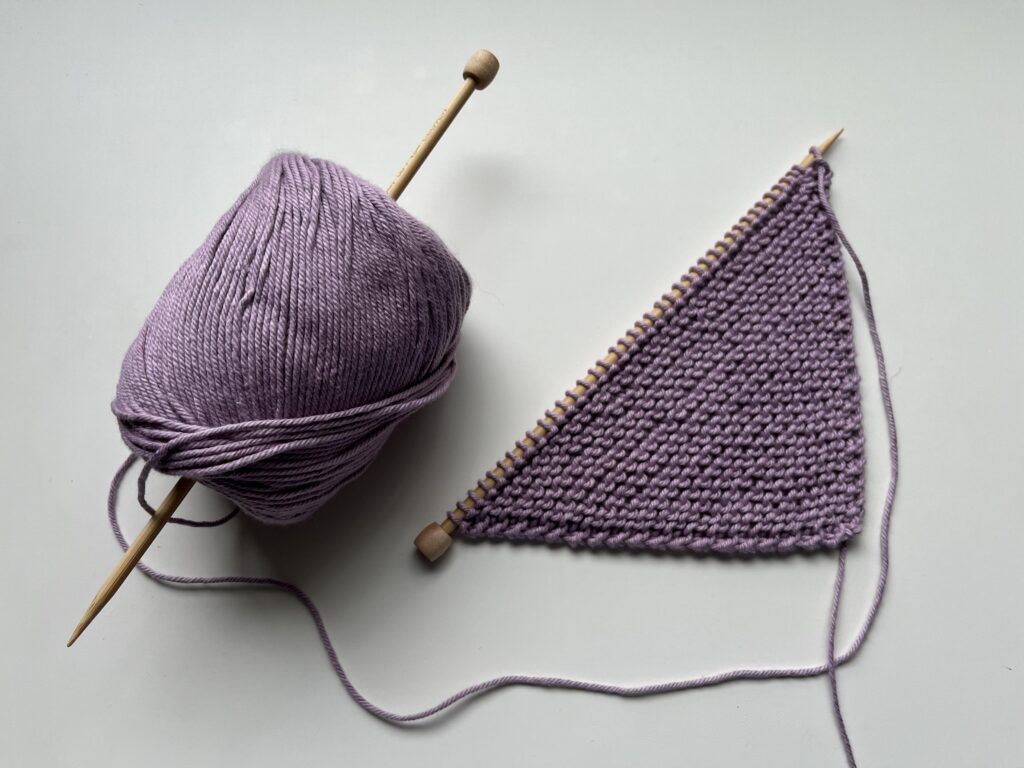
I also plan to add more patterns to Ravelry! I have a scarf that I intended to write up and publish a decade ago, but life happens… you can take a look at the washcloth, now.
And hopefully, I will also have the time to get in the occasional knitting-related blog post, whether skill-building related, calls to action, or personal essays.
But keep an eye on the space, and I will try to share on socials (bluesky and Insta) and do my best not perish from being seen!
Happy crafting! Don’t forget to take good care of yourself <3
The knitter-net is full of discourse on the Red Hat, and while I won’t opine on that in this moment, I will say that if the symbology of the hat is important and heartening for you, by all means, be comforted by it. The main takeaway I have is that we cannot be equating making and wearing a red hat with the work that needs to be done – the red hat is not going to make ICE go away, it is not going to provide ongoing support for people harmed by them (I know there are donations associated with the pattern…), it is not going to change hearts and minds, it is not going to buy groceries for people unable to leave their homes, and it’s not going to demand better from anyone that has the power to do better/more when they are representing us on Capital Hill, and it is certainly not going to end systemic racism and imperial injustice on stollen land. Just as the pink pussy hats of 2016/17 did not keep Roe from being overturned and did not keep the sitting president from being the sitting president yet again.
But, if knitting is where your capabilities are at this moment, then here is how to turn that knitting into community care.
Many mutual-aid groups need cozy items for colder months and climates. This can be hats, mitts, and scarves. If it is not cold enough in your area for there to be a need for these items, perhaps look outside your area for need, and/or start planning ahead for your own area – an early start can mean a bulk donation. You will want to search for mutual-aid groups, group homes for the housing insecure (think homes for women and children or group homes for recovery or recidivism), and folks that distribute clothes and groceries to those in need of them. Once you’ve identified a home, make sure that they accept the items you’d like to send and you’re in the proper window to be donating cold weather items – there may be a list on their site or you may need to reach out to them directly.
If now is still a good time, get started, and if not, perhaps inquire if there are other needs you can meet. And if you have the extra cash, you can donate funds directly.
If it’s a go, then choose fibers that won’t be too much of an itch issue, colors that are wearable, and styles that are gender-neutral so they can go to anyone who needs them. Washability is also very important – someone who is living in a shelter or who has limited access to washing machines or needs to put all their things in one load at the laundromat, will not be able to give your hand-knits special treatment. If your stash is full of rustic wool and your funds are limited, try reaching out to other knitters and see if they have some stash they’d like to share with you for the cause. Thrift shops also tend to have inexpensive donated yarn, lots of it acrylic.
I have a few suggestions below for simple items that most knitters could make:
Fingerless Mitts by Roxanne Richardson – knit flat and then sewn together, using knits and purls, however, if you aren’t a confident purl-er, you could probably make these entirely in garter stitch. This is adjustable in size, so grab some folks of various hand-sizes and ask to measure on them, or go to the Craft Yarn Council to look for standardized sizing: https://www.craftyarncouncil.com/standards/body-sizing
Totally Triangular Scarf by Michelle Krause – this is knit flat, and just requires knit, purl (one purl stitch at the end of the row), kfb, and k2tog, slipping the first stitch, and weaving in ends. It’s made with 100g of worsted weight yarn, and to make it easier (no weighing), you can use two 50g balls. I use my kitchen scale to know when I’ve made it to the center-ish. You could also omit the purls and slip stitches if you aren’t comfortable with those, and it would only change the way the edging looks.
Basic Beginner’s Hat by Maggie Billings – this pattern is knit in the round, and is designed to be a first hat project. However, someone could use the same materials and knit it flat and then seam it – with or without decreases (knitting a rectangle and just cinching at the top, instead of decreases- this requires extra yarn, however).
I have a YouTube playlist of the techniques used, and additional similar item tutorials, here.
These all take smaller amounts of yarn – 100g or less – and could be made in a weekend. You could increase the impact by getting other knitters together for a day or over the course of a few days, either in the same space or separate spaces, and then donate your items as a group.
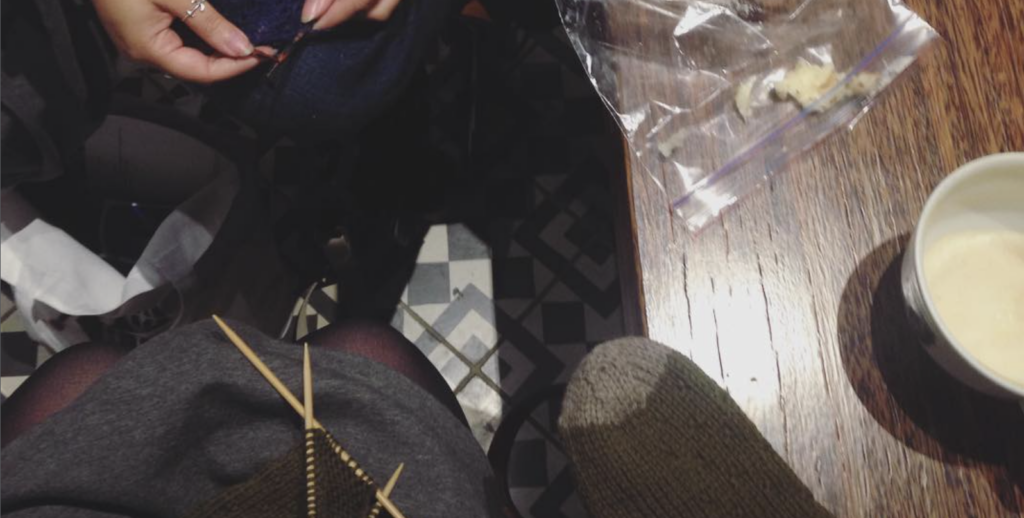
This weekend, I joined a number of crafters at a local bar Stitch & Bitch, and we all made scarves to be handed out with lunches for folks that are food-insecure. It was a great way to meet like-minded people that want to use their skills and supplies to redistribute resources.
If you’ve looked around and cannot find a place for your goods, look to see if there are community pantries where you could leave a box of items out for folks to rummage through. See if your local soup kitchen or food bank would put out a box of knit accessories. Ask around at a schools schools and see if they take donations for kids and their families. This act of searching will help you get connected to local organizers and mutual-aid groups in your area. This can also be useful if you or someone you know ends up experiencing hardship, too – you will already know where the helpers are.
For me, the framing of these gifts is also important. You may have noticed that I use “mutual-aid” instead of “charity.” Mutual-aid is community care, it is sharing resources with peers – I am closer to being homeless than I am to being in the wealthy owning class. Charity feels like something that is off and away, it is the haves bestowing a fraction of what they have on the have-nots to easy some guilt or to make them feel good about themselves. Mutual-aid says,I see you, you are my community member, and we will look out for each other. It is on-going, it recognizes our shared humanity, and it sustains us.
This act of looking for the helpers, and joining in community care is one of the most buoying things you can do. We are daily bogged down with the harm and the need and being asked to individualize rather than harmonize. We see those at the top continue to enrich themselves rather than paying workers fairly, and use their funds to make a worse world for the majority of us.
The darkness of it all has illuminated the coming together. So, if you are ready to go beyond the red hat as symbol of outrage, and start putting in the work for a better future, it’s perfectly fine to start softly with mutual-aid knits, and learning more about how we got here, so we can move to something better, together.
I encourage you, while you’re knitting, to listen to podcasts and audiobooks by smart and empathetic folks, so you can feel empowered to speak out and be a change-maker. And please do so via your local library with apps like Libby and Hoopla – Audible/Amazon needs no more of your money nor you data.
This washcloth pattern was made out of necessity – I am teaching beginner knitting, knew that a diagonal washcloth would be part of the curriculum, and then when I went to find one that would work, I could not.
So, my first published pattern on Ravelry (because it’s there, too) is just something that people have been making for ages, centuries perhaps, because I wanted to make sure that it was written down and readily available.
This diagonal washcloth is knit flat in Garter Stitch and uses simple increase and decrease stitches, great for building skills in knitting. This pattern makes a 6 inch washcloth, but the size is adjustable – you could even just keep going until you have a blanket…
A note about materials – you want to avoid multi-colored yarn if you are a beginner making this, because that will make it harder to see your stitches and read your knitting. You don’t need to add any unnecessary grief to the process of learning to knit! Enjoy your project and choose something with a smooth texture and a solid color! Also, do not choose Loops & Threads cotton if you love yourself at all – it is a pain to work with. I use Dishie (linked in the materials list) and while it is $5 per ball, that ball will make you three or four of these washcloths, so that’s not bad. Yes, you will need to pay for shipping if you don’t hit the free shipping minimum, but you will also spend money traveling too-and-from a Michael’s and then again when you go back to get something else, instead. Please just do yourself a favor and leave that stuff on the shelf.
K1fb – Knit one front and back – knit the front leg of the stitch, but don’t remove it, then knit in the back leg of the same stitch, then remove it from your left needle; you now have two new stitches from one stitch.
K2tog – Knit two together – knit two stitches together by inserting your needle through the front leg of the next two stitches, left to right, and then knitting as if it’s one; you now have one stitch on your right needle from the two on your left.
Pattern Instructions:
Cast-on three (3) stitches, using the long-tail cast-on or preferred cast-on method.
Increase Section:
Row 1 Knit (k) across all three stitches on your needle.
Row 2 K until the last two stitches on your needles, k1fb, k1 (1 stitch increase)
Cont. Continue to knit each row as in Row 2, increasing by 1 stitch in every row, until you’ve reached 40 stitches, or until your square sides reach the desired length.
Decrease Section:
Dec. Row Knit until the last 3 stitches on your needle, k2tog, k1 (1 stitch decreased)
Cont. Continue each row as above, down 1 St per row, until only 3 stitches remain.
Cast-of With 3 stitches remaining, cast off all stitches. Weave in ends.
I hope you enjoy making this washcloth, either for yourself or for someone you care about!
This is where to start to master the knitting basics that will set you up to knit whatever your heart desires. The course consists of four in-person classes, access to online instructions, and a resources library set up to help you continue your skill building.
Agenda: In the first class, you will learn the knit stitch, and practice on a set of needles with the stitches already cast on. At the second class, you will learn to cast-off those stitches (finish the edge and remove the fabric from the needles), cast-on a new piece, and follow basic instructions to make a small object. The third week, you will learn to increase and decrease stitches, creating a shape on the diagonal. And in the final week, you will learn the purl stitch, giving you the ability to create a variety of fabric textures. You’ll also receive free patterns and learn how to create your own.
Materials: Initial materials (knitting needles, yarn, etc.) will be provided at the first class. There will also be a basket of donated yarn to choose from for the coming projects. If you’d like, you are also welcome to acquire your own materials, using the provided guidelines (i.e. thickness of yarn that is compatible with the project and needles).
———————————————————-
The Next Session Starts in February 2026
This session is FULL, I’ll be looking to add another, soon!
Schedule: The next class begins on Thursday, February 5th, at 6 PM, and will run each Thursday in February. Because the skills are progressed and each class is structure to build on the last, please plan to come to each class in the course. The location will be near S St & 29th in Midtown / Newton Booth.
Class size: At this time I can take about 6 students. If there is more interest, I will see if I can secure an assistant so that everyone gets adequate hands-on help.
RSVP: You can email me or message me through Signal (where we will have our class group chat)
Email: workingyarns (at ) onenetbeyond . org
Signal: ( at ) stephanie . 119
If you send me a DM, please specify the class so that I know it’s not a spam message – thanks!
This class is provided by Sacramento Free School, and is on the Spring 2026 Calendar. The calendar updates on January 25th, so be sure to check out all of the classes!
I’ve seen quite a bit of content about how knitting has been used in resistance, to send secret messages, etc., but what stands out to me in this time is just how vital community is, and how knitting creates instant community.
Two of my very best friends are people that I met because of knitting. They remain vital parts of my life, and one of them is the reason why I have kiddo.
Knitting has made meeting new people easier through finding a crew to craft with. I’m currently a member of an anticapitalist group of crafting folks. We share resources and information beyond patterns and yarn; one member has offered legal advice to my partner, I’ve received donations for the knitting class that I’ll be teaching, and we have a mutual aid channel on the discord. We are there for each other and there for the community in ways that I have not seen in other circles, including an early life full of church-going. It’s far better than church.
One of my goals this year is to grow community through craft, making, mending, growing, and building – anolog, physical, in-person – I want to know who is around me, I want to say “hi” as I bike, walk, or drive through the neighborhood. I want to know the skills and resources of trusted folks in my community so that we can all help each other as needed.
The knitting community I have here is part of that. Teaching knitting, I hope, will help me to expand that to more folks.
While I’ve been moving away from social media, I’ve kept my knitting account active. And there, I follow local mutual aid and community groups. It keeps me connected to what is here and now, what I can be part of in the physical.
It is through community that we stay grounded. It’s where we see humanity in action. It’s where we can vision something other than what we were born into, where we grow our understanding of what is needed and what is superfulous. It’s where we understant abundance beyond our personal bank accounts, pantries, and closets.
So, crafters can be radical and send secret messages and all that, but what is more radical than sharing resources? What is resistance if not chosing togetherness over devision and creating the world we want in real time and space? Not to mention, chosing something tactile over the digital landscape?
Here’s to you, chosing to touch grass and/or yarn. I hope you find in-person community that feeds your soul if you haven’t already.
It’s actually happening! I’ll be teaching my first learn to knit course this late-winter/early spring, and I couldn’t be more excited!
As I film instructional videos and upload matterials for the course, I will be sure to share them here so that you can follow along.
The course will likely start in February, so I hope to have everything completed and posted in January.
I will go over basics like the knit and purl stitches, casting on and off, and how to read yarn labels so that you have the right matterials for what you’d like to make.
I’ll begin thinking about a 2.0 class for the F/W26 season as well, so that folks feel ready to make themselves cozy items and/or gift knits.
Here’s to more people learning this cozy craft!
Have you ever taught a craft? If you have any tips for me, I’d be most grateful for them.
I learned to knit about 20 years ago. The practice hasn’t been steady. I made a few wonky scarves. I used a loom to make a couple of hats. I then learned crochet because I wanted to make stuffed animals (amigurumi) and knitting them seemed too complicated when I was still adding extra stitches by accident.
The crochet helped me become a better knitter, and I picked the craft back up again several years later when I needed something to help me cope with a heavy course load – I’d knit while I listened to the audio book version of what I needed to read, with the kindle app open to the same on my iPad, taking breaks from stitches to highlight text that I wanted to refer back to or making a quick note. Knitting helped me remember, helped me relax, and gave my brain a break from academic work. I started my knitting blog, on blogger, around that time, as well as a knitting Instagram account, back in the days before it was sold and monetized.
My guage became predictable during that time, and I started to grow my skills with the help of youtube tutorials and knitting blogs (I link to some of these on my Resources page).
Knitting also carried me through my (first) divorce, helped me calm and regulate, and I started to explore more complexity with colorwork, lace, and cables. I made my first pair of socks, in worsted weight yarn, which I recommend for any first-time sock knitter.
In 2017 I had a moth infestation take out most of my yarn, and that put my knitting on the back burner for a while. I would pick it up occassionally to make a hat or a pair of socks as a gift, but I didn’t want to do something large-scale after loosing a sweater quantity of good yarn ($$$), a big cozy shawl, and a number of other beautiful skeins I’d been dreaming of turning into more complex lacework.
I knit even less once my kiddo was born mid-2020. I’d made a few baby things while I was pregnant, but this kid did not want me making any more, not until she was nearing 4 years old. I started back up again making a few things for Waldorf preschool life – slippers for inside play, a hat and a kercheif for outside winter play, etc. I started to knit for myself again, too – kercheifs and triangle scarves.
This year has been my big return back. I frogged a cotton top that I had started in 2020 and worked it into a pattern I’d purchsed back in 2018 that was perfect for summer in my new town (hotter than I’m used to). I started a sweater – at last! – and made socks with tiny needles and sock yarn, when I’d only ever done house socks before. I made more slippers. I made a new hat. I knitted stuffed animals for the first time. And I have an extensize list of things to make before this year is up, too, both for girfts and for the kiddo’s winter faire at school.
And while I have been knitting a way this year, I have had a request to teach, and a suggestion to share those same lessons with another group, as well.
While I used to blog and share tutorials, I was not the most qualified to do so and am certainly surprised (and maybe a bit delighted) at my audaciousness at that time of life. I only shared what I knew, thinking that perhaps other beginners would enjoy the beginner perspective, and hoping it would push me beyond the crippling perfectionism that had me taking on new skills at a snails pace.
I am still perhaps not the most qualified, but this year I noticed that I’ve grown quite a bit and am now able to do something that I could not before – I can accurately read my knitting. What I mean is, that if I make a mistake, I can look and see what I’ve done wrong, and I am able to go back and fix what is fixable. And because I’ve got a stead pace, tension, and gauge, I knit without really looking and make more mistakes than I did when I needed to pay close attention. These mistakes have relaxed me, made me more confident, and helped me to let go of the type of perfectionism that stagnates progress; I still strive for neat and beautiful stitches, but I no longer fear ruining things or being unable to come from what feels like disaster.
So, I’ve decided I will say yes to teaching – at least the beginners – and I will help others to read their knitting and set them up to grow and maybe even become better knitters than I will ever be.
Knitting has given me so much more than warmth on a cold day. In fact, my child would not exist if I didn’t knit (which is a story for another day). It is empowering. It is active rest (quite necessary for my AuDHD brain). It is good for my brain. It is good for my body. It’s a tool for sharing my love and affection. It is a way to have high-quality garments in the age of fast fashion. And on and on… Who am I to keep the knowledge of the craft to myself?
My hope is that after teaching this class a couple of times, I will be able to publish the materials, and maybe even a virtual class, here. This way, more folks can access it and those who studied with me will also have the resource readily available and shareable.
So, do keep an eye out for something in the Spring! In the meantime, I will share bits here and there as they come to mind.
I wish you well!
Stephanie
———————————–
Parting Note: At this moment, I don’t know how to set up this blog as a newsletter, so you can also join me on Substack until then, but the ultimate goal is for all newsletter/blog activity to be on this platform where you are guaranteed your information will not be sold off.